Call for Papers

INTERNATIONAL CALL FOR PAPERS
SPECIAL ISSUE ON TIME BANKS TO MARK THE 30TH ANNIVERSARY OF THE CREATION OF THE TIMEBANKS ASSOCIATION IN THE UNITED STATES

The Ibero-American Association of Time Banks (ASIBDT), together with the Timebanks.org Association and the International Journal of Community Currency Reserach (IJCCR), on the occasion of the celebration this year 2025 of the 30th anniversary of the creation of the Time Banks association in the United States, are opening an international call for papers on time banks, time-currencies and time-based exchange networks, which will be published in a special issue dedicated to this anniversary in The International Journal of Community Currency Research, IJCCR (www.ijccr.net), The journal is a periodical published by the RAMICS association (https://ramics.org), founded in 1997 and since then serving as a global benchmark in the academic world in its field. It has published a great number of articles about and around timebanking during that time (see references for examples). 

To mark this important anniversary for the time banks in the United States, we are opening the possibility for academic and non-academic articles on the history, present state and future potential of time banks in this country and worldwide. 

The deadline for submitting articles and reviews in English or Spanish for this special issue will be February 1st 2026. We believe this is an opportunity for researchers and academics interested in contributing original work, which may include reviews, meta-analyses, empirical studies, theoretical and conceptual articles on time banks and other networks or organizations that use time as a unit of exchange. Also, articles on time-based exchange networks and time-based currencies are welcome. We will accept articles in three categories: 

1. Research articles 
Articles which provide an informed theoretical perspective as well as empirical investigations of time banks and time based currencies. 

2. Literature review articles
Articles that provide literature review of the field of time banks, time based currencies or socially centered accounting systems, reciprocity and gift economy. 

3. Empirical research reports & letters from the field 
This would be field studies and particularly noteworthy case studies. We welcome in particular empirical research reports from ongoing projects and from PhD students who want to share research results before their dissertation is concluded. 

The guidelines for article acceptance are the same as those required by The International Journal of Community Currency Research and can be found at the following link on the journal’s website: https://ijccr.net/submit-a-paper-2 . 

By March 7th, 2026 all participants will be notified by email of the results of this call for papers. 

The further procedure depends on the type of article you submit. Research articles are subject to a peer review process. 

A first selection of papers will be presented on March 23, 2026, on the celebration of International Timebanks Day, as part of all the virtual events that ASIBDT and Timebanks.org, together with other organizations, are holding worldwide for this reason. 

The editors of this special issue are renowned academics in the field of complementary currencies and managers of various time bank networks that currently exist worldwide. 

EDITORS 

  • Sarah Bird, CEO of Timebanking UK, United Kingdom 
  • Prof. Dr. Georgina Gomez, Erasmus University, Netherlands 
  • Prof. Dr. Lee Gregory, University of Nottingham, United Kingdom 
  • Dr. Jens Martignoni, Chief Editor IJCCR, Switzerland 
  • Grazia Pratella, President of The Coordination Time Bank in Lombardy, Italy 
  • Julio Gisbert Quero, President ASIBDT, Spain 
  • Maurizio Ruzzene, Independent Researcher, Italy 
  • Krista Wyatt, Executive Director and CEO at TimeBanks.Org, USA 

WEBSITE FOR SUBMITTING ARTICLES: https://ijccr.net  *Please note that online article submission will be unavailable from November 24 to 28, 2025, due to a platform migration.

MORE INFORMATION: info@asibdt.org 

Latest articles about time banks in IJCCR:

8th CCCS Conference, Rio de Janeiro, 2026

8th Biennial RAMICS International Congress in Brazil

“Plurality of Social Currencies: solidarity economy, municipal and community currencies for inclusive and sustainable futures”

Rio de Janeiro, Brazil, June 8-12, 2026

This image has an empty alt attribute; its file name is image-2.jpeg
This image has an empty alt attribute; its file name is e59bb31.jpg
This image has an empty alt attribute; its file name is e59bb32.jpg

Official Website

>> Download the program here <<

Important dates:

ActivityDate
Submitting abstracts  January 31st, 2026 (Saturday)
Notification of acceptance  March 1st, 2026 (Sunday) 
*Proposals submitted before the deadline will be evaluated and communicated in advance.
Registration deadline Early Bird: April 2nd, 2026 (Thursday) 
Late Registration: April 22nd, 2026 (Wednesday) 
Submitting full papers  May 24th, 2026 (Sunday)
Conference  June 8-12th, 2026  

For submission and registration, check the official website.

Address: Rio de Janeiro (Brazil), FGV Headquarters Building (Praia de Botafogo, 186 – Botafogo, Rio de Janeiro – RJ)

Organization of the Congress:

  • Centro de Estudos em Microfinanças e Inclusão Financeira (FGVcemif) 
  • Programa de Engenharia de Sistemas e Computação (PESC/COPPE/UFRJ)
  • Instituto Federal do Rio de Janeiro (IFRJ)
  • Universidade Federal da Bahia (UFBA)
  • Universidade Federal Fluminense (UFF)
  • Research Association on Monetary Innovation and Community and Complementary Currency Systems (RAMICS)

Title of the Conference:

  • 8th Biennial RAMICS International Congress in Brazil. Plurality of Social Currencies: solidarity economy, municipal and community currencies for inclusive and sustainable futures

Conference Presentation

The Ramics research association focuses on studying monetary innovation and community and complementary currency systems. Since 2011, the network has met every two years to share experiences, ideas, and practices on complementary currencies.

The 8th congress will be held in Rio de Janeiro, Brazil, June 8-12, 2026.

In a global context marked by growing mistrust in governments and widening gaps between local and central institutions, complementary and community currencies have emerged as innovative tools to rebuild social and economic connections. Across the world, these initiatives foster solidarity, inclusion, and resilience by creating local exchange systems and sustainable models of development rooted in community participation. Numerous experiences have been developed in different regions, each with distinct characteristics, objectives, and institutional arrangements.

Beyond their economic function, these currencies serve as instruments of social innovation and democratic experimentation. They encourage collective governance, stimulate local entrepreneurship, and strengthen citizens’ capacity to act within and beyond traditional market logics. By doing so, they invite a rethinking of value, cooperation, and sustainability in contemporary economies, aligning financial practices with broader social and environmental goals.

The 8th Biennial RAMICS Conference, entitled “Plurality of Social Currencies: Solidarity Economy, Municipal and Community Currencies for Inclusive and Sustainable Futures,” seeks to deepen and enrich the debate on these initiatives. Through lectures by national and international experts, presentation of academic research and experience reports, and field trips, the event aims to foster interdisciplinary dialogue and exchange of experiences, contributing to the advancement of discussions on solidarity economy, local development, and financial inclusion.

Conference website (for paper submissions and additional details): https://ramics2026.sciencesconf.org/

Organizing committee:

Prof. Anderson Oriente (IFRJ, Rio de Janeiro) 

Prof. Ariádne Scalfoni Rigo (UFBA, Salvador) 

Prof. Bruno Chapadeiro Ribeiro (UFF, Niterói) 

Prof. Eduardo Diniz (FGV, São Paulo)  

Prof. Lauro Gonzalez (FGV, São Paulo) 

Prof. Luiz Arthur Silva de Faria (UFRJ, Rio de Janeiro) 

Marcos Rodrigo Maciel Ferreira (UFRJ, Rio de Janeiro) 

Prof. Paula Duarte (FGV, Rio de Janeiro) 

Pedro Paulo Gonçalves neto (UFRJ, Rio de Janeiro) 

Rogério de Castro Melo (FGV, São Paulo)

Themes for paper presentations are:

  1. Digitalization, and technologies
    • Suggested key words: 4th industrial revolution, digital currencies, cryptocurrencies, blockchain, digital divide, governance, centralization, software licenses, digital sovereignty, digital financial inclusion etc.
  2. Territories, and participation
    • Suggested key words: empowerment, decentralization, decommodification, (re-)distribution, social cohesion, social innovation, community resilience, local development, participation, regional, local, governance, civil society, community currencies, citizenship etc.
  3. Public policies, and relations with governments
    • Suggested key words: federalism, basic income, debt crises, poverty, inequality, liquidity, inflation, ethical finance, social harmony, social justice, centralization, governance, institutional arrangements, legal framework, municipal currencies etc.
  4. Environment, and sustainability
    • Suggested keywords: degrowth, perpetual pandemics, energy transition, natural resources, ecology, green new deal, green investment, climate change, biodiversity, energy poverty, agroecology etc.
  5. History and theories
    • Suggested key words: monetary reform, history, transition phases, typologies, design, theoretical review, conceptual propositions etc.
  6.  Emerging themes and other approaches (in case your work is not covered by the other themes).

More information will be published here and in the official website in due time, sign up to our newsletter to be the first to hear about it. For submission and registration check the official website.

Scientific Committee (in alphabetical order)

Prof. Anderson Oriente (IFRJ, Rio de Janeiro, Brazil)

Prof. Ariádne Scalfoni Rigo (UFBA, Salvador, Brazil) 

Prof. Bruno Chapadeiro Ribeiro (UFF, Niterói, Brazil)

Prof. Eduardo Diniz (FGV, São Paulo, Brazil)                                                         

Prof. Ester Barinaga, University of Lund (Sweden) 

Dr. Gabriella Gimigliano, University of Siena 

Prof. Georgina Gomez, ISS, University of Rotterdam (Netherlands) 

Dr. Jens Martignoni, Zurich University of Applied Sciences (Switzerland) 

Prof. Jerome Blanc, Triangle, Sciences Po Lyon (France) 

Prof. Lauro Gonzalez (FGV, São Paulo, Brazil) 

Dr. Luca Giachi, CNR Issirfa (Italy) 

Prof. Luiz Arthur Silva de Faria (UFRJ, Rio de Janeiro, Brazil) 

Prof. Masayuki Yoshida, Joetsu University of Education (Japan) 

Prof. Paula Duarte (FGV, Rio de Janeiro, Brazil) 

Dr. Rossitsa Toncheva (University of National and World Economy, Bulgária) 

Additional information:

On June 4, 5, and 6, 2026, there will also be an additional event organized by the Conference of the Brazilian Network of Community and Municipal Banks, to be held at the Casa de Rui Barbosa Foundation, in Botafogo, Rio de Janeiro.

The Conference of the Brazilian Network of Community and Municipal Banks aims primarily to strengthen the networks of popular and solidarity economy initiatives supported by community and municipal banks across the country. In addition, the event will serve as a space for organizing the movement’s agendas and advocacy priorities, as well as for electing the Network’s new board of directors.

The conference will bring together approximately 250 participants, including leaders from civil society organizations from more than 100 cities, researchers, national and international public officials, and other invited guests.

Further information will be available on the RAMICS 2026 website: https://ramics.cos.ufrj.br

Message from the President upon completing mandate

Dear members

As the year draws to a close, so too does my term as president of Ramics. I want to thank all our members for this valuable learning experience and offer a summary of the past four years. I presented these activities at the 7th Congress in Rome, but as not all members were able to attend, I want to highlight some key points.

Over its ten years of existence, Ramics has become a valuable resource: a space where researchers on complementary currencies can present and discuss their work, a point of contact for the public with questions on our topic, and a source of literature for young researchers needing to start out somewhere. The Ramics email address regularly receives unsolicited offers, from tourist boards inviting us to hold conferences in their cities to service providers offering website improvements. While these emails can be a nuisance, they do indicate a degree of visibility among global academic associations. 

Over the last four years, Ramics has maintained its activity, holding biennial conferences in various countries and continents. The post-COVID congress was made possible primarily through the dedication of Rossitsa Toncheva, with crucial support from the rest of the Management Team, her team in Sofia, Bulgaria, and our long-standing volunteers, Leander Bindewald and Teodoro Criscione. The subsequent congress, organized by ISSIRFA CNR in Rome, marked a positive step beyond the pandemic. Like a historical turning point, this shift towards the future took place in Rome, a city with a rich history of such transitions. I extend my sincere thanks to CNR and the Roman team—Luca Giachi, Chiara Cavallaro, Riccardo Fava, Francesca Proia, and Fabrizio Tuzi—for organizing the congress, and to Matthew Slater for the practitioners’ day. I also offer sincere thanks to Teodoro Criscione, who provided wonderful support as a volunteer once again.

After three rounds, we have established a Best Paper Award, open equally to activists and researchers. The blending of practitioners, academics, and activists has become one of the hallmarks of Ramics conferences. While the contacts between the groups has got varying degrees of success, Ramics is still among the few academic associations that actively engage such a diverse audience. This year a new bridge was built, with a community of educators, an initiative of Ester Barinaga. Finally, we have continued to support small groups of PhD students in France, Sweden, Belgium, Japan, Brazil, and the Netherlands. The Ramics Management Team page provides a list of potential PhD supervisors for research on complementary currencies.

The International Journal of Community Currency Research (IJCCR) deserves special mention. Jens Martignoni and the Editorial Board are working to revitalize the journal, exploring ways to enhance it while adhering to the founders’ mandate: to provide high-quality, open-access research. Despite its limitations, the IJCCR stands as one of the few free and open-source journals sustained by volunteer effort for 27 volumes. The Editors also offer mentoring to aspiring junior scholars, helping them achieve their first publication rather than simply issuing rejections. For papers focusing on case studies, ideas, and projects, the IJCCR has created the “Ideas for Debate” section, publishing innovative and well-written empirical cases.

Unfortunately, in early 2024, our second attempt at a COST Action proposal was unsuccessful, joining the 92% of proposals that were rejected. I have decided to step aside, allowing others to try a third time or develop a different proposal if they wish. The existing documentation remains available to all Ramics members.

When I took over the presidency from Jerome Blanc in 2019, I had many more plans and wishes. Time constraints and other limitations kept me focused on what was achievable, altogether humbler. I benefited from the motivation of current and former Management Team members, as well as Ricardo Orzi in Argentina and August Corrons in Barcelona, our former Management Team members. I would like to welcome Gabriella Gimigliano and Luca Giachi from Italy into the MT. I am also grateful to the many volunteers who have dedicated their time and energy to help us grow and maintain a degree of visibility and relevance.

Having reached my word limit, I offer my best wishes for 2025. May this year bring peace and some prosperity to the world, and perhaps some sanity and rationality to world leaders who have shown a lack thereof. And may Ramics make its own small contribution towards these goals.

Georgina Gomez

New management committee members

The members of the new Management Committee for the period 2024-2026 have been decided.

Georgina Gomez, who had been the President until now, has stepped down, and Rossitsa Toncheva has been appointed as the new President. Moreover, August Corrons Gimenz and Ricardo Orzi have stepped down from the Management Committee, and Gabriella Gimigliano and Luca Giachi have been appointed as new members.

For more information, please see Management Committee.

[ RAMICS Congress Rome 2024 ] International Activists’ Day

We are pleased to announce that on Saturday 9 November from 10am to 6pm the activists’ day will be held at Millepiani Coworking (Via Nicolo Odero, 13, 00154 Rome RM). 

In the registration form (and payment) for the conference you will be able to indicate if you want to participate in the activists’ day. Participation is free of charge.  Those who have already completed the registration form for the conference will receive an email to confirm their participation in the day. 

On the final day we shall attempt to put theory into practice: If money a tool for collaboration should not money experts be the best collaborators on the planet? Matthew Slater, who has designed some recent ‘Collaborative Finance’ events, will design this final day for 
•⁠  ⁠spending some time socialising (creating conditions for collaboration), 
•⁠  ⁠helping each other, in the room, on othe spot, there and then,
•⁠  ⁠Imagining forms of longer term cooperation.
Before you arrive, have a think about how your colleagues might be able to help you. 

The activists’ day will therefore be coordinated by Matthew Slater, for any information please contact him directly via this email: matslats ( at ) fastmail.com.

Alternative Economic and Monetary Systems (AEMS) Summer School 2024

Summer University, Vienna; 15 July – 02 August 2024

What is AEMS?

The AEMS summer university presents and discusses the state of the art in alternative economic and monetary systems. There is overwhelming evidence, that the current economic model based on everlasting economic growth is destroying the ecosystem of our planet and contributing to the global climate crisis. Therefore, the summer university wants to shed light on approaches and reform proposals that can make a real difference. AEMS offers room for critical thinking and the possibility to openly discuss and deconstruct ideas and concepts with distinguished experts from various scientific fields. Lectures, workshops and discussion panels enable the participants to acquire a deeper understanding of the intricate interactions of society, ecology and economy.

After successful completion, the international participants receive a certificate from BOKU University, awarding them with 5 ECTS points, which equals 125 study hours. The summer university is the result of a collaboration between OeAD student housing, the University of Natural Resources and Life Sciences, Vienna (BOKU) and representatives of the Economy for the Common Good (ECG), as well as more than 60 international supporting institutions and partner universities.

AEMS Modules

1. Economics with Social and Ecological Values

2. Society, Money and Institutions

3. Towards a social ecological economy

4. Wrap-up and Synthesis

More information at http://www.summer-university.net

Contact: Ms. Mag. Carina Kamptner, BA & Ms. Petra Isepp, BSc; AEMS program management, OeAD student housing, Ebendorferstrasse 7, 1010 Vienna; email address: aems@oead.at

[Event] Collaborative Finance #2 | Serving Local Communities

Check the original webpage.

DATES. Arrive from 6pm, Sunday June 30th, 2024 Leave around 6pm Thursday July 4th, 2024Many of us will take a train to #CoFi Liege which starts the next day!

LOCATIONHike Bike Twike Grote steenweg 44 B-3400 Ezemaal (LANDEN) Belgium.

COSTS. Full ticket: €250 including meals & accommodation. Day drop in: €35 including meals.

Introduction.

We need to re-organise work, wages, cooperation, food, community, procurement, health, education, even government. Financial innovation is a critical part of the solution, re-imagining investment, ownership, pensions, money, cooperation, supply chains and resilience.

There are too many ideas to process, it can be hard to look beyond our specialist bubbles and impossible to coordinate, to agree, to plan.

#CoFi is a space for meeting, knowing each other, building trust, cooperation and hopefully, building power. In our first gathering we showcased payment systems architectures, and how credit is created and circulates and extinguished within them.

But finance is just numbers if it doesn’t serve the real economy. This July, the Crypto Commons Association is proud to offer CoFi 2, where we will start to bridge alternative finance to other alternatives!  #CoFi isn’t intended to be super-geeky; grassroots building requires building broad alliances rather than competing for market niches.

If you are still reading, you’re invited to Banja Luka at the end of June. We want to see practitioners not only in payments tech, but in community building and community finance, food networks, barter networks, business networks and everything adjacent.

If you can’t make June 28th to July 3rd, do also consider the Crypto Commons Gathering (sign up to CCA’s newsletter for the future announcement!) which brings together blockchain practitioners working towards tangible social benefits.

Who Are The Organizers?

We have been leaders in the field of complementary currencies for many years.

  • Matthew Slater co-founded and provides free software for Community Forge, which hosts web sites for hundreds of LETS groups. See his web site.
  • Stephen DeMeulenaere originally from Canada and based in Asia has been active for over 30 years in the field in numerous, mostly 3rd world countries, and for many years kept the definitive global database of complementary currencies and library literature, and has also worked extensively in the blockchain space. See his profile.
  • Crypto Commons Association has co-organised the first CoFi Gathering in May 2023, and generally promotes the development of Crypto Commons/Commons Economy infrastructures, through contents, research (Check out the Commons Economy Roadmap) and events.

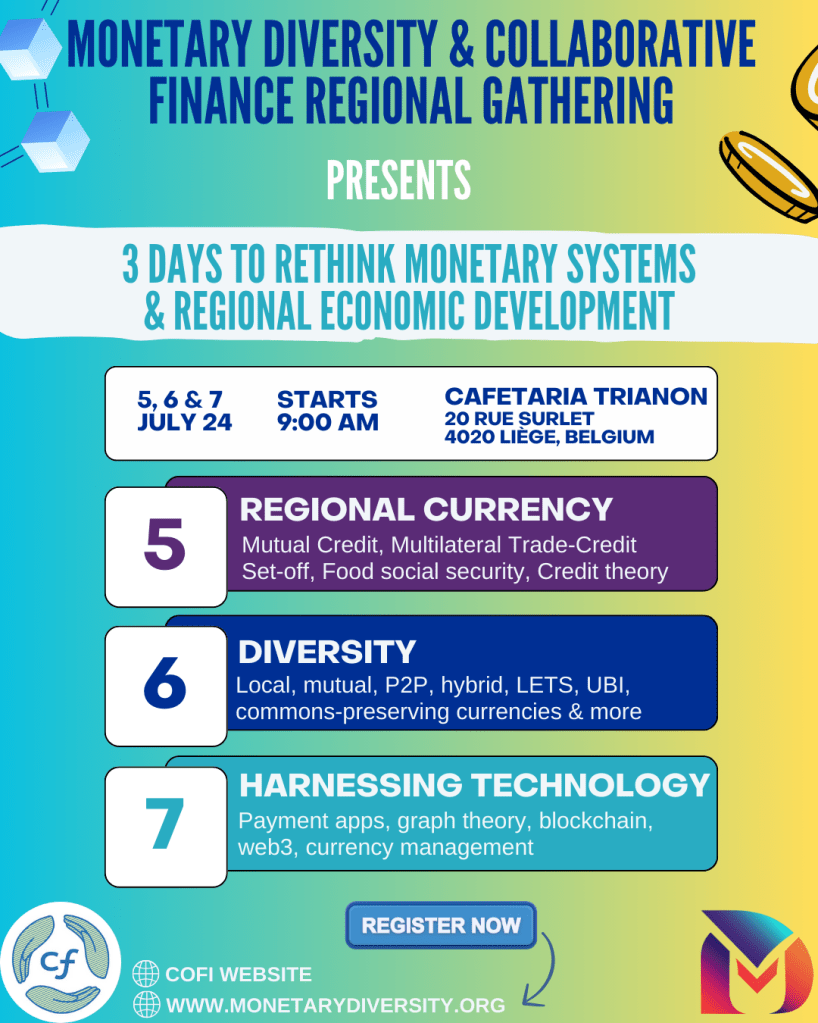
[Event] Monetary Diversity & Collaborative Finance Regional Gathering

Registration Link [ here ] at Monetary Diversity (MoDi) website.

Three days to rethink our monetary system and alternatives

Monetary Diversity and Collaborative Finance Regional Gathering. Join us in the historic and vibrant city of Liège, Belgium, from July 5th to 7th, 2024, for a transformative three-day event that is part of the renowned CoFi Roadshow. Hosted by Collaborative Finance (CoFi) and Monetary Diversity (MoDi), this gathering is a pivotal moment for anyone interested in the forefront of monetary innovation.

Towards regenerative and sustainable financial and monetary systems

Our aim is to ignite discussions, share insights, and foster collaborations that will advance the use of alternative and complementary currencies or accounting systems. This event is a unique opportunity to bring together thinkers, practitioners, innovators, and reformers from all corners of the local currency, mutual credit systems, and blockchain technology sectors.

Who Should Attend?

  • Academics and students intrigued by economic reform and monetary theories
  • Professionals and entrepreneurs in the finance and technology sectors
  • Representatives from NGOs and community groups focused on economic resilience and sustainability
  • Policymakers and governmental officials interested in economic, financial and monetary innovation for regional activities

Why Attend?

  • Learn from leading experts through a series of conferences covering the latest trends, research findings, and case studies in the realm of alternative finance.
  • Engage in working sessions designed to foster collaborative projects, brainstorming solutions, and building networks among participants.
  • Build Bridges across different sectors to create a unified front for monetary and economic reform.

Languages:

The event is held in Ennglish

Highlights:

  • Keynote speeches from internationally recognized pioneers in the field
  • Panels and roundtables addressing critical issues facing the alternative currency movement
  • Hands-on workshops aimed at developing practical skills and knowledge in implementing local currency systems and leveraging blockchain technology
  • Networking opportunities to connect with like-minded individuals and organizations

Join Us in Liège:

Be part of a movement that is setting the stage for the next wave of financial innovation. Whether you’re deeply embedded in the world of alternative currencies or just starting to explore the possibilities, your voice and participation are crucial.

Mark your calendar for July 5th to 7th, 2024, and prepare to dive deep into discussions that will shape the future of finance. Together, we can explore the potential of alternative and complementary currencies to create more inclusive, sustainable, and resilient economies.

Don’t miss out on this opportunity to be at the forefront of monetary innovation. Secure your spot at the CoFi & MoDi event in Liège today!

Organised by 

Nicolas Franka, Monetary Diversity (MoDi) 

With the support of Collaborative Finance (CoFi) and CCA (Crypto Commons Association)

Stephen Demeulenaere, Matthew Slater & Giulio Quarta 

Registration Link [ here ] at Monetary Diversity (MoDi) website.

New Resource (In Spanish)

Implementation Guide

The Council of Barcelona has released a new Methodological Guide for the Implementation of Local Currencies with public government intervention. It has been authored by August Corrons y Lluís Muns, graphic design by Pedro Imaz.

The guide is free to download in this link (in Spanish), links at the bottom of the page.

Enjoy the reading!

Ramics Management Committee

Dear members

Thank you for joining us in the association and in our great congress in Sofia.

We will send you a lengthier report in the next newsletter in the beginning of 2023. However, at this point we wanted to share a few highlights and one of them is that we are going to resume the circulation of newsletters twice a year. You can find the old ones here.

We wanted to quickly update you on the composition of the 4th Ramics management Committee, its activities and resources. We held our first meeting immediately after the general Assembly in Sofia on October 29th, 2022. By this message we would also like to inform you on who to address for your various interests.

  • Georgina Gómez (Erasmus remains as President of the MC
  • Eduardo Diniz becomes Co-president
  • Jérôme Blanc continues as Treasurer
  • Ester Barinaga continues as Secretary
  • August Corrons continues as Secretary and Co-Editor of the IJCCR
  • Jens Martignoni becomes Chief Editor of the IJCCR journal
  • Masayuki Yoshida takes responsibility for communication. This includes the Newsletter and Announcements
  • Ricardo Orzi and Rossitsa Toncheva continue as members of the Management Committee

Rolf Schroeder continues to curate the CC-Lit but he has retired from the Ramics Management Committee. Yannick Lung was responsible for communications and has retired from the Management Committee. We thank both of them for their contribution and hope they continue to support the association as members and participating in conferences.

More news will follow!