[International Roundtable] Cooperation for Open-Source ICT development for Solidarity Economy and Community Currency Systems

Call for an International Roundtable: Cooperation for Open-Source ICT development for Solidarity Economy and Community Currency Systems.

The more Solidarity Economy is growing the more is the need of ICT tools to support it. Platforms to manage a new economy, new monetary and financial structures, which reflect a new way of living are urgently necessary. In the last decades, several tools have been developed, but the fast evolution of technology requires an increasingly expensive cost of maintenance and start-up. A new wave of technologies, such as Artificial Intelligence and Blockchain, will increasingly change the digital world and its impact on reality. We think this will be a big opportunity to enhance the resilience and the self-reliance of communities, starting from considering the following Social Innovations which are able to re-shape the world into a fairer place:

First Roundtable. Local Food and Small-scale Retail Channel Networks.

– Co-production,

– Community Supported Agriculture,

– Cooperative Agriculture and Farmer Networks,

– Small-scale Retail Channel,

– Local Marketplaces,

– Platform for Purchasing Groups,

– Community Privacy Data Protection.

Second Roundtable. Social and Community Currency Systems.

– Crowdfunding Campaigns and Community Investments (e.g. reward-based, equity-based, donation-based),

– Mutual Credit and Time-banking Systems,

– Reward-based Currency Scheme for Social Projects.

The Festival

The Roundtable is hosted by FESTA DELL’ALTRA VELOCITÀ, for more information please click here.

When: from 29/06/2018 to 1/07/2018

Where: c/o ASD Avigliana Calcio, Via Oronte Nota 3, 10051 Avigliana (TO)

An entire event dedicated to the growing sector of Solidarity Economy: presentations of projects, conferences, debates, and roundtables. We wait for you at Avigliana, in Val di Susa, from 29 June to 1 July 2018!

> REGISTRATION <

All the developers are invited to introduce himself or herself and present his or her projects during the first session of each roundtable.  Send your application at teodoro.criscione(at)dr.com by the 3rd of June 2018. For any question do not hesitate to contact us at the same mail address.


[ Online Course ] – The first Community Currency Design Course is online

We are honored to announce that the first Community Currency Design Course is now available for free on the Grassroots Economics website. The quality of the course is surely granted by the extraordinary experience and knowledge of Dr. William O. Ruddick and his staff behind the Grassroots Economics organization. The course is divided into 5 modules, each one dedicated to a specific topic. Mainly addressed to practitioners, the goal is to understand how to set up and design a community currency project. [ 1 ]

Click here to start the MOOC

Background

On May 2010, Dr. William O. Ruddick introduced Eco-Pesa to three informal settlements inside Kongowea Location in Mombasa County, namely: Kisimu Ndogo, Shauri Yako, and Mnazi Mmoja. Later he founded Grassroots Economics Foundation and in 2013 developed the Bangla-Pesa model based on the results of Eco-Pesa, in the informal settlement of Bangladesh, Kenya.

A 50 Bangla-Pesa note

Other currencies in Kenya that follow the Bangla-Pesa model include Gatina-Pesa in Kawangware, Kangemi-Pesa in Kangemi, Lindi-Pesa in Kibera, Ng’ombeni-Pesa in Mikindani. K’Mali in Kokstad South Africa, as well as Berg-Rand or BRAND in Bergrivier South Africa, also follow a similar model. [ 2 ]

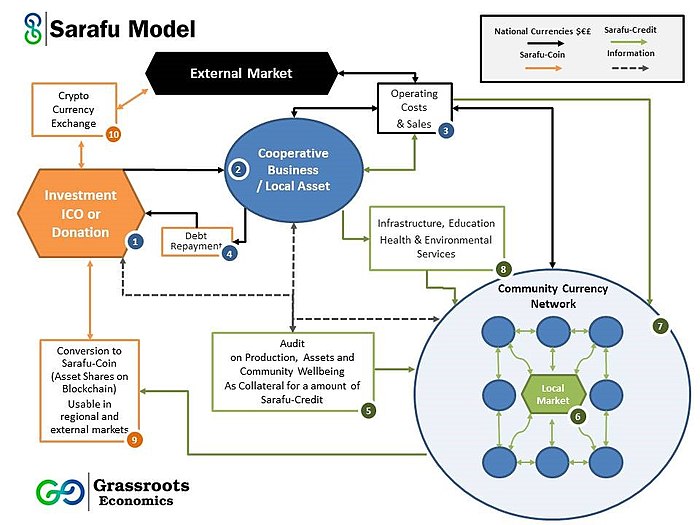
All local currencies that emerged after the Eco-Pesa in Kenya (six in 2017) experience are now grouped under the label Sarafu-Credit, but they originally were issued under the supervision of an association named Koru Kenya, which does no longer exist. In 2017, six communities are currently using Sarafu-Credit in Kenya totaling over 1200 users. The system is the same in all of them, though each community uses its own version of Sarafu-Credit, giving it a unique name depending on the local toponyms, and managing it independently. [ 3 ]

About the author

Dr. William O. Ruddick is a development economist focusing on East Africa. After completing graduate school researching high energy physics as a collaboration member at the Stanford Linear Accelerator Center, he found his analysis skills and passion drawn to alternative economics and development. Since 2008 Will has lived in East Africa and managed several successful development programs in environment, food security and economic development. He is dedicated to connecting communities to their own abundance, and is an advocate for, and designer of, Complementary Currencies for poverty eradication and sustainable development. Dr. William O. Ruddick has pioneered Community Currency Programs in Kenya since 2010 and is the founder of the award-winning Bangla-Pesa program. He consults on Community Currencies worldwide and while researching with the University of Cape Town’s Environmental Economics Policy Research Unit. Dr. William O. Ruddick is also an associate scholar with the University of Cumbria’s Institute for Leadership and Sustainability. [ 4 ]

Sources

[ 1 ] https://www.grassrootseconomics.org/mooc

[ 2 ] https://en.wikipedia.org/wiki/Eco-Pesa

[ 3 ] https://en.wikipedia.org/wiki/Sarafu-Credit

[ 4 ] Dr. William O. Ruddick Linkedin Profile


[PhD Offer] Multidisciplinary PhD in Currency Innovation

IFLAS has been researching and teaching on local currencies, crypto currencies and blockchain since 2014 when our University became the first public University in the world to accept bitcoin. Since then we have always had Ph.D. students studying this area, taking a multidisciplinary approach, drawing upon social theory to explore the implications for the public of a multicurrency future.

We are now seeking new applications for Ph.D. research in this field, to start October 1st 2018. The opportunity is suited to people who work on this topic and could do a Ph.D. part-time over 4 or 5 years. They would work alongside a full-time Ph.D. student who works with the new Lake District Pound, and with Professor Jem Bendell as their supervisor. Most supervision is provided remotely, and so the number of visits to campus during the programme can be negotiated (the July 2019 summer school is obligatory).

There is no funding, but the fees for part-time students with UK or EU residency are very competitive (under 2000GBP a year).

If you already have a Masters degree and are interested, please write one page about your idea for your research and your motivation, and send it before May 10th to Professor Jem Bendell (email: jem(dot)cumbria(at)cumbria(dot)ac(dot)uk). If your idea is relevant, then you will hear within a week of initial contact and be invited to submit a formal application before the end of May to enable an October 1st start.

More information on our Institute is available at www.iflas.info

More information on our views on blockchain and crypto is here.

Our latest peer-reviewed paper on the topic, from Prof Bendell, is here.

Our international engagement on this topic is via Prof Bendell chairing the organizing committee of a UN event on blockchain. Information here.

Source: http://iflas.blogspot.it/2018/04/multidisciplinary-phd-in-currency.html

[Call for EU COST Proposal – AnDroMeDA Project] Assessment of Distributed Ledger Technology for Multi-Domain services Adoption: Hoax or Opportunity?

The Main Proposer Dr. Antonio Carnevale opens to RAMICS members for collaboration on AnDroMeDA project. The project is focused on Distributed Ledger Technologies and their applications, also for community development and monetary innovation. The proposal has been already submitted as EU COST project, but it is possible to contact Dr. Andrea Carnevale to be involved in it.

The aims of AnDroMeDA are (1) providing a map of the concepts and outlining a multidisciplinary vocabulary of DLTs  (Distributed Ledger Technologies) use; (2) stimulating and coordinating more specific research projects to compare current knowledge and real experiences about how DLTs can really find applications in different societal and strategic fields; (3) developing a pan-European network that can help Early Career Investigators (ECI) to grow up; (4) to release disseminative materials that synthetically illustrate criticalities and opportunities of DLTs.

Ledgers have been at the heart of commerce since ancient times. However, in all this time the only notable innovation has been computerization, which initially was simply a transfer from paper to bytes. Now, for the first time, Distributed Ledger Technology (DLT) enables the collaborative creation of digital ledgers with properties and capabilities that go far beyond traditional paper-based ledgers. Their tangible innovative character is that DLTs can operate smoothly and securely without the need of being controlled and administered by a central or third party. This makes DLT a potentially radical change in the future mentality and methods that lead both the governance and management of techno-science and the participation of people in decision-making processes. It is evident that, according to these premises, DLTs have been rapidly elected as the object of controversial debates: are they a real opportunity or only a promise?

For more information, please contact Dr. Antonio Carnevale at alephkaf@gmail.com.

[International Conference] The Variety of Exchange and the Character of Money

17 & 18 May 2018

Ecole normale supérieure
salle Dussane

Organiser : Kuroda, Akinobu (U of Tokyo) in cooperation with Georges Depeyrot (CNRS/ENS, Paris)
Funded by Japan Society for the Promotion of Science (project No 26285073)

Programme

17 May

13:00-15:00

  • Kuroda, Akinobu (U of Tokyo)
    The Aims of the Workshop
  • Bruno Théret (Université Paris Dauphine)
    Exchange and debt. Discussing Kuroda’s quadrangle in light of current discussions around debt-money versus fiat money
  • Georgina Gomez (IISS)
    The institutionalization of currency circuits (case of Argentina)
  • Jérôme Blanc (Lyon 2)
    Money and interdependencies : a structural view

16:00-17:30

  • Ekaterina Svirina (Higher School of Economics, National Research University)
    Variety of money in Siberia in the 18-19th century
  • Jürgen Nautz (Ostwestfalen-Lippe University of Applied Sciences)
    Money and national identity in Austria-Hungary


18 May

9:30-11:00

  • Leigh Gardner (LSE)
    The gold standard in Africa : Monetary dimensions of interwar imperialism
  • Karin Pallaver (U of Bologna)
    Disconnected currencies : cents and rupees in early colonial British East Africa

11:15-1300

  • Craig Muldrew (U of Cambridge)
    Tracking the rise in the use of paper instruments of currency in London c.1700-1800
  • Kuroda, Akinobu (U of Tokyo)
    Strategic peasants, multiple markets, and Complementary currencies
  • Georges Depeyrot (CNRS/ENS)
    Concluding Remarks

Source: http://www.ens.fr/agenda/variety-exchange-and-character-money/2018-05-17t110000

[Workshop] LabEx ReFi, Columbia University, Alliance : The End of Cash

The end of cash

PRÉSENTATION

Sovereign currencies are being undermined by digital tokens, local currencies and exchange systems, while cashless payment systems are flourishing in emerging countries. Is it to say that the state is losing its monetary authority on the economy? Or shall we say that these new developments are just means to finance projects? The workshop will introduce theoretical points of view on multiple-currency economics, review innovative solutions and regulatory initiative.

PROVISIONAL PROGRAM

Thursday 26th and Friday 27th April


Thursday 26th – Time: 2 pm – Venue: 407 Low Library


1. Intro & statement of problems (2-3 pm)
a. General intro (PCP)
b. Banking, money and credit: A systemic perspective (YB)

2. Digital currencies – a challenge to public authority? (3-4:30 pm)
a. Would complementary currencies eventually submerge cash (Jérôme Blanc)?
b. When local currencies go global (Arthur Breitman)?
c. The end of privacy? (Brett Scott)
d. Legal challenges of virtual currencies (Anastasia Sotiropoulou)


Friday 27th  – Time: 8:30 am – Faculty House, Garden Room 1.


3. Alt currencies implemented

a. Panel 1 – New payment systems in the emerging world (8:30-10)
i. Prepaid payment systems in Africa (Akil Amiraly)
ii. Payment Systems Role in Financial Inclusion, Government Policy and Effect on Developing Nations: Evidence from Kenya and Rwanda (Frank Cotae)
iii. Governmental strategies in the Southern theatre of the global “war on cash” (Sally Brooks, Daniela Gabor, Philipp Mader)

Coffee break

b. Panel 2 – News from the Old World (10:30-12)
i. Preferences for non-cash payments in EZ (Mechtild Schrooten, Armin Varmaz)
ii. Non-cash remittances rely on blockchain (Fred Marcusa)
iii. What are Crypto worth? – an empirical survey (Pc Pradier)

Lunch

4. Payments systems of the future towards the future of payment systems (2-4 pm)
a. Financial education and the future of payment systems (Georges Ugeux, Columbia)
b. Do central banks favour competitive market solutions or centralization (Antoine Martin, Fed New York)
c. A cost-benefit analysis of generalizing intant payments (Rémi Steiner, CGE, France)
d. Digital base money in Europe (Andrea Pinna, DG market infrastructure and payment services, European Central Bank)

REGISTRATION

Source: http://www.labex-refi.com/event/workshop-labex-refi-eifr-risques-extremes-crises-cybermenaces-et-plans-de-continuite-dactivite-dans-le-milieu-financier/?instance_id=980

[PhD Offer] Funded PhD on Local Currencies

Fully funded full time PhD on local currencies in stunning Cumbria, supervised Prof. Jem Bendell. Closing date: midnight 18 February 2018.

sovi_cs_logo

The Lake District Pound (LD£) initiative is the context within which the research project will be carried out. This is an innovation in local currency that builds on the prior work and positive outcomes of other complimentary currency initiatives in the UK and globally. The LD£ will operate alongside sovereign Sterling currency with a more direct purpose to support the local rural economy.

This initiative will utilise a range of innovative methods to adapt and extend the idea of a ‘currency with a purpose’ to a rural context with a unique demographic including for the first time a National Park. A core aim of the initiative is to shift visitor spending from using large external businesses (e.g. online retailers and travel companies, remote delivery services, etc.) towards local companies and communities. The anticipated impact is to retain more wealth in the region to fund social and environmental projects and through the local focus and supply chains deliver measureable environmental benefits.
The LD£ initiative has a number of short and long-term aims, which will be greatly enabled through this research project. The aim of the research project is to provide a foundation and framework for measuring the success of the local currency initiative and from that measure, to identify optimum practice and future direction to improve such local currency initiatives.

The PhD research topic is the development of a framework for evaluation of the impact of the Lake District Pound and generation of data on that impact. This evaluation must include indicators of economic impacts, as well as social, cultural and environmental impacts. The evaluation needs to involve quantitative metrics, but can also include more qualitative assessments. It is a multidisciplinary study, with the candidate being able to draw upon a range of fields in consultation with the supervisor (for instance, potential insights from sociology, accounting, corporate sustainability, voluntary sector and organisation studies).

The PhD researcher will work with The Lakes Currency Project Ltd as well as conducting the research for the PhD – and will be based in the stunning Lake District National Park.

The Lakes Currency Project Ltd is the organisation behind the introduction and support of the ‘Lake District Pound’. It is incorporated as a private entity following the guidelines of a Community Interest Company to drive the LD£ initiative as a commercially sustainable project. The generation of revenue from the initiative will be directed in joint partnership with the Lake District Foundation to support vital sustainability projects in and around the National Park, and the Cumbria Community Foundation to support critical projects to help the poorer local communities. Their long-term aim is to develop an element of autonomy and economic resilience within the Lake District and surrounding communities in response to the continually increasing impact of global tourism that often serves to impoverish rural areas.

Benefits

Full-time PhD – annual tax-free stipend of £15,000 p.a. for 3 years
Tuition fees paid for by the industry sponsor (Home/EU fee)

The PhD is supported by the ERDF funded Eco-innovation Cumbria project led by the University of Cumbria.

Application process

To apply please visit the website for details of the entry requirements which must be met and to access the application form. Under the Research Proposal section of the form please summarise your approach to the proposed project outlined in this advert under the following headings: General Overview of Area, Identification of the Relevant Literature, Key Research Questions, Methodology, Timescale/Research Planning

Please include a covering letter telling us why you want to study for a PhD, what interests you about this project and highlight the skills and experience you will bring. Give the title of your research proposal as: “The Lake District Pound: Developing Local Sustainability through Economic Innovation in a Rural Context

For any queries relating to admissions please contact Research Student Admissions rsa@cumbria.ac.uk

If you wish to find out more about the project in the first instance please contact: Ken Royall, Chief Executive, The Lakes Currency Project Ltd. ken@lakedistrictpound.com or Dr David Murphy, Institute for Leadership and Sustainability, University of Cumbria david.murphy@cumbria.ac.uk

Closing date: midnight 18 February 2018.

Interviews to be conducted 26th February 2018 in Ambleside, Cumbria. Candidates will be required to give a short presentation on their approach to the research proposal. Strong candidates may be given the option for an interview by video conference.

Source: Prof. Jem Bendell’s Website

Facebook Post

[Event] Festival for New Economic Thinking (19-20 October 2017, Edinburgh, UK) – RAMICS will be there!

Wordmark-DoubleBanner-Blue

The very first Festival for New Economic Thinking will take place on 19-20 Oct 2017 in Edinburgh (Scotland) prior to the INET 2017 Conference,  taking place from 21-23 Oct 2017.

The Festival brings together organizations and individuals that seek to improve the way economics is taught, studied, and practiced. It provides a forum to share ideas and resources with students, academics, and the wider public.

With content from many organizations within the same large event space, participants can explore exhibits, watch screenings, take part in workshops, and learn from inspiring speakers. Actively celebrating and embracing different perspectives and schools of economic thought, the Festival for New Economic Thinking aims to provide fertile ground for the future of economics.

RAMICS will be present at the first ‘Festival for New Economic Thinking’ at the Edinburgh Corn Exchange, 19-20 October 2017. If you have the chance, come and see us at stall 19.

Download the program here.

[RAMICS] IV International Conference on Social and Complementary Currencies: Closing Remarks

logo-conferencia-cast-1%201

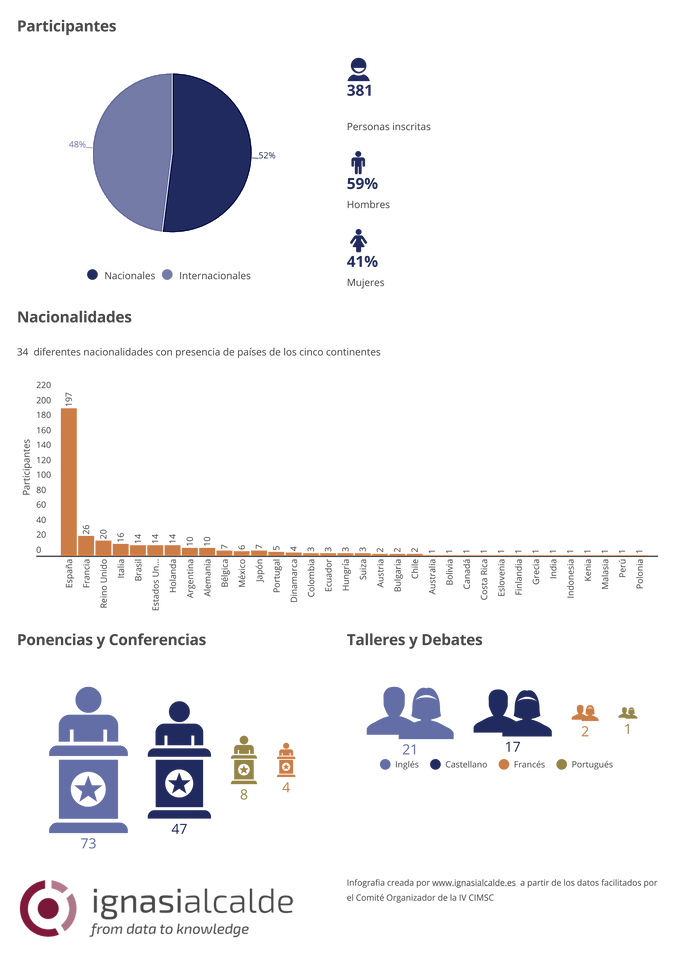
The IV International Conference on Social and Complementary Currencies was a big success. More than 300 scholars, students, and practitioners participated in this event in Barcelona. A detailed report will follow in our newsletter. The General Assembly of RAMICS confirmed the work of the previous Management Committee. All five members of this Committee were re-elected. In addition, August Corrons from Barcelona and Ricardo Orzi from Buenos Aires were elected too. Teodoro Criscione was confirmed as communication manager.

Infographic

Source: www.dineroyvalores.com 

Further information

Papers and Presentations

Videos

Photos

Press

Social Currency Systems in Spain

List of Contacts 

Source: www.dineroyvalores.com