The session of “RAMICS Book Corner” will take place on Wednesday, February 11, from 05:00 to 06:00 PM (Central European Time) RAMICS Book Corners aims to be regular sessions in which recently published books on monetary alternatives are discussed with their authors. Louis Larue will discuss his recent book with Juan Ocampo (Pontificia Universidad Javeriana, Bogotá) […]
The first session of “RAMICS Book Corner” will take place on Friday, October 17, from 01:00 to 02:00 PM (Central European Time) RAMICS Book Corners intends to be regular sessions where recently published books on monetary alternatives are discussed with their authors. I will (and anyone interested) discuss Ester Barinaga Martín’s book with her:Remaking money for an inclusive […]
We are pleased to announce that on Saturday 9 November from 10am to 6pm the activists’ day will be held at Millepiani Coworking (Via Nicolo Odero, 13, 00154 Rome RM).
In the registration form (and payment) for the conference you will be able to indicate if you want to participate in the activists’ day. Participation is free of charge. Those who have already completed the registration form for the conference will receive an email to confirm their participation in the day.
On the final day we shall attempt to put theory into practice: If money a tool for collaboration should not money experts be the best collaborators on the planet? Matthew Slater, who has designed some recent ‘Collaborative Finance’ events, will design this final day for • spending some time socialising (creating conditions for collaboration), • helping each other, in the room, on othe spot, there and then, • Imagining forms of longer term cooperation. Before you arrive, have a think about how your colleagues might be able to help you.
The activists’ day will therefore be coordinated by Matthew Slater, for any information please contact him directly via this email: matslats ( at ) fastmail.com.
DATES. Arrive from 6pm, Sunday June 30th, 2024 Leave around 6pm Thursday July 4th, 2024. Many of us will take a train to #CoFi Liege which starts the next day!
LOCATION. Hike Bike Twike Grote steenweg 44 B-3400 Ezemaal (LANDEN) Belgium.
COSTS. Full ticket: €250 including meals & accommodation. Day drop in: €35 including meals.
Introduction.
We need to re-organise work, wages, cooperation, food, community, procurement, health, education, even government. Financial innovation is a critical part of the solution, re-imagining investment, ownership, pensions, money, cooperation, supply chains and resilience.
There are too many ideas to process, it can be hard to look beyond our specialist bubbles and impossible to coordinate, to agree, to plan.
#CoFi is a space for meeting, knowing each other, building trust, cooperation and hopefully, building power. In our first gathering we showcased payment systems architectures, and how credit is created and circulates and extinguished within them.
But finance is just numbers if it doesn’t serve the real economy. This July, the Crypto Commons Association is proud to offer CoFi 2, where we will start to bridge alternative finance to other alternatives! #CoFi isn’t intended to be super-geeky; grassroots building requires building broad alliances rather than competing for market niches.
If you are still reading, you’re invited to Banja Luka at the end of June. We want to see practitioners not only in payments tech, but in community building and community finance, food networks, barter networks, business networks and everything adjacent.
If you can’t make June 28th to July 3rd, do also consider the Crypto Commons Gathering (sign up to CCA’s newsletterfor the future announcement!) which brings together blockchain practitioners working towards tangible social benefits.
Who Are The Organizers?
We have been leaders in the field of complementary currencies for many years.
Matthew Slater co-founded and provides free software for Community Forge, which hosts web sites for hundreds of LETS groups. See his web site.
Stephen DeMeulenaere originally from Canada and based in Asia has been active for over 30 years in the field in numerous, mostly 3rd world countries, and for many years kept the definitive global database of complementary currencies and library literature, and has also worked extensively in the blockchain space. See his profile.
Crypto Commons Association has co-organised the first CoFi Gathering in May 2023, and generally promotes the development of Crypto Commons/Commons Economy infrastructures, through contents, research (Check out the Commons Economy Roadmap) and events.
Three days to rethink our monetary system and alternatives
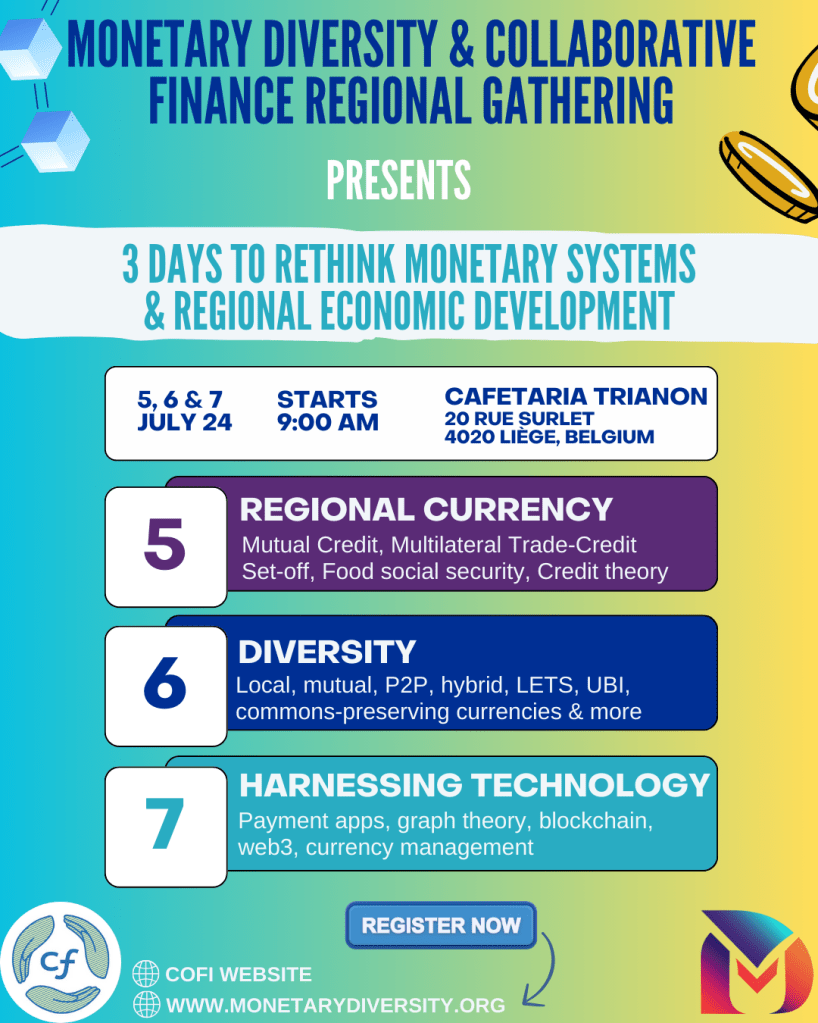
Monetary Diversity and Collaborative Finance Regional Gathering. Join us in the historic and vibrant city of Liège, Belgium, from July 5th to 7th, 2024, for a transformative three-day event that is part of the renowned CoFi Roadshow. Hosted by Collaborative Finance (CoFi) and Monetary Diversity (MoDi), this gathering is a pivotal moment for anyone interested in the forefront of monetary innovation.
Towards regenerative and sustainable financial and monetary systems
Our aim is to ignite discussions, share insights, and foster collaborations that will advance the use of alternative and complementary currencies or accounting systems. This event is a unique opportunity to bring together thinkers, practitioners, innovators, and reformers from all corners of the local currency, mutual credit systems, and blockchain technology sectors.
Who Should Attend?
Academics and students intrigued by economic reform and monetary theories
Professionals and entrepreneurs in the finance and technology sectors
Representatives from NGOs and community groups focused on economic resilience and sustainability
Policymakers and governmental officials interested in economic, financial and monetary innovation for regional activities
Why Attend?
Learn from leading experts through a series of conferences covering the latest trends, research findings, and case studies in the realm of alternative finance.
Engage in working sessions designed to foster collaborative projects, brainstorming solutions, and building networks among participants.
Build Bridges across different sectors to create a unified front for monetary and economic reform.
Languages:
The event is held in Ennglish
Highlights:
Keynote speeches from internationally recognized pioneers in the field
Panels and roundtables addressing critical issues facing the alternative currency movement
Hands-on workshops aimed at developing practical skills and knowledge in implementing local currency systems and leveraging blockchain technology
Networking opportunities to connect with like-minded individuals and organizations
Join Us in Liège:
Be part of a movement that is setting the stage for the next wave of financial innovation. Whether you’re deeply embedded in the world of alternative currencies or just starting to explore the possibilities, your voice and participation are crucial.
Mark your calendar for July 5th to 7th, 2024, and prepare to dive deep into discussions that will shape the future of finance. Together, we can explore the potential of alternative and complementary currencies to create more inclusive, sustainable, and resilient economies.
Don’t miss out on this opportunity to be at the forefront of monetary innovation. Secure your spot at the CoFi & MoDi event in Liège today!
Cambridge, MA June 15-17, 2023 HARVARD LAW SCHOOL Sponsored by: INET; PERI, University of Massachusetts, Amherst; LPE@HLS; APPEAL; Harvard Law School; University of Würzburg
Hamburg, Germany June 15-16, 2023 THE NEW INSTITUTE AND HAMBURG INSTITUTE FOR SOCIAL RESEARCH Sponsored by: Hamburg Institute for Social Research and THE NEW INSTITUTE; University of Würzburg
Keynote Speakers
The Honourable Mia Amor Mottley, Q.C., M.P.
Prime Minister of Barbados
Saule Omarova, Professor of Law
Cornell Law School
Call for Panel and Independent Paper Proposals (Deadline: Feb. 01, 2023)
Submit: Panel Proposal or Submit: Independent Paper Proposal
We are delighted to announce Money as a Democratic Medium 2.0. The Conference will be held at two sites in order to maximize participation while minimizing carbon impacts: Cambridge, MA (Harvard Law School, June 15-17, 2023) and Hamburg, Germany (the Hamburg Institute for Social Research and THE NEW INSTITUTE, June 15-16, 2023). The Conference is open to all students of money, credit, and finance, the monetary system, and the modern economy, including members of the public. We will offer robust online access and we encourage distant participants to join us virtually.
The Conference includes opportunities for specialized exchange in panel sessions and plenary events of interest to the broad audience.
For specialized panel sessions, we welcome proposals by February 1st, 2023. To propose a panel, please submit your proposal using the link provided above or on the conference webpage: https://justmoney.org/money-as-a-democratic-medium-2-0/. Your material should include panel participants, paper abstracts (1-2 pages each), and a confirmed commentator. We will receive independent paper submissions, but their chances of acceptance depend on the vagaries of other submissions. Panels and papers in the areas identified below are particularly encouraged. In addition, there will be limited opportunity for emerging scholars (i.e. undergraduate and graduate students) to workshop with experienced faculty. Dependent on participant interest, zoom “poster board” sessions will also allow participants to share work and receive feedback online.
Additional plenary sessions will be announced.
Registration for the Conference will open on March 1st, 2023.
Overview Money has moved to the front and center of debates over democratic governance. In the five years since our first conference (Money as a Democratic Medium 1.0, 2018), scholarship and policy contention in the field have exploded. Money as a Democratic Medium 2.0 takes that development as its focus. The Conference aims to amplify inquiry, research, and debate over money as a public project. The 2023 meeting will bring together those working across disciplines, locales, and subject areas to consider the way societies make money and allocate credit as an essential element in the way they govern themselves.
Recent events compel the focus. Twice over the last two decades, governments world-wide have leapt to rescue the financial infrastructure that undergirds modern markets. The amounts they appropriated, the way they distributed those funds, and the decision-makers who controlled the process – all raised questions about democratic voice and accountability. In the United States alone, officials in 2008 committed more than $5 trillion in lending, guarantees, or financing to firms operating in the capital markets, while individuals who lost homes scrambled for relief. In the COVID-19 pandemic of 2021, the Federal Reserve mobilized the same magnitude of funds at even greater speed to maintain the markets for public bonds, corporate borrowing, and other financial assets. Proactive after the experience of 2008, Congress’s emergency spending still failed to match the Fed’s, even as it faced repeated obstacles, drew the ire of deficit hawks, and triggered blame as the catalyst for inflation. The very character of the monetary architecture seemed skewed to fail the people it was said to serve. In Europe, too, the two global crises significantly changed the structure of government and the economy. The ECB and national banks have since played a significant role in supporting the financial sector with the aim of preventing economic collapse inter alia through large-scale quantitative easing. The pandemic, furthermore, prompted unprecedented fiscal measures, not only at the member state, but also the EU level. Yet, governments stopped short of complementing the monetary with a fiscal union and discontent has been rising about the distributive effects of monetary as well as fiscal policy.
Other phenomena escalate that concern. As the evidence of rising inequality mounts, so do arguments about how monetary drivers, from financial instability to predatory credit structures, may contribute to it. Financialization appears to have taken on a life of its own. On the one hand, the industry continues as a critical interface in the markets. On the other hand, scholars document increased returns to traders without any gains in efficiency or accessibility to most individuals. Stabilizing that sector remains the conventional priority of central banks. At the same time, climate change gains destabilizing force at the existential level, challenging those institutions, legislatures, and the banking industry to turn the power of modern money-making towards the ultimate public welfare. Over the past few years, a new set of institutions and approaches have attempted to promote alignment of the financial system with the Paris Agreement, and to manage climate-related risks to the financial system. Largely untheorized, these new institutions and approaches require discussion as to their strengths and weaknesses.
Each of these issues reverberates globally, joined by an array of other exigencies. Monetary sanctions, for example, carry grave geopolitical ramifications: some see a route around expanding militarized conflict, while others decry the strategy for creating new nation-state blocs. The status of the dollar as the global currency comes in for daily debate; shifts in its hegemony would mean regional realignment across the globe. Meanwhile, the Eurozone’s experiment in monetary governance has wrapped representative institutions, courts, and transnational organizations into novel relations. Residents there and in polities across the globe debate degrees of “monetary sovereignty” as an index of self-determination. That concern is closely tied to rising burdens of sovereign debt, a challenge configured by patterns of early and current colonialism. The phenomenon implicates both international financial organizations and the fractured landscape of debt resolution and restructuring.
The 2023 MDM Conference, like its predecessor in 2018, distinctively frames new work on money, credit, and the financial architecture: it recognizes them as elements of a public project rather than privately produced phenomena. Given that frame, the Conference will focus on the following themes. (1) Issues of institutional design, (2) the fit of that design to democratic governance, and (3) the globalization of monetary structures as a challenge to domestic decision-making.
First, we invite work that opens monetary institutions to view. Comparative and historical work suggests that societies have experimented constantly with different monetary structures and methods of allocating credit. Everyday experience reiterates that lesson. The crises of 2008 and 2020, the rise of cryptocurrencies, the European Monetary Union, recurring sovereign debt crises – all have catalyzed intense debates over institutional reform. The Conference will feature work that enables us to explore more effectively the complex engineering that produces modern money and credit, to evaluate the way our monetary orders have changed and the capacities at stake when they do, and to consider causal connections previously obscured, including the relationships between governmental structures and market processes. The focus will include arguments about forward-looking institutional alternatives, like central bank digital currencies, the political and normative premises that shape them, and their impact on shaping the modern political economy.
Second, the Conference directs attention to the claims that the public rightfully makes on the monetary media organized in its name. Recent scholarship on money details the governmental infrastructure that undergirds most moneys, the public obligation that anchors demand for the medium, and the enforcement and regulatory practices that consolidate the payments system. That public commitment suggests that we have profound legal and political obligations to evaluate monetary design as a matter of democratic governance. But such a mandate arguably collides with the very structure of the modern financial architecture, which insulates central banks to ensure their independence while incorporating significant commercial bank voice into their administration. The intricacy of modern finance compounds the challenge, as does the expansion and important role of expertise in monetary policy, bank management, and financial development. The question remains how members of a monetary community can participate in the way that body operates, how they can claim fair access to the medium, and what structures engender well-being and opportunity, as opposed to dearth and exclusion.
Third, and new in 2023, the Conference will focus on the global dimension of monetary governance. From the dynamics of the Gold Standard to the taper tantrum of 2013 to the crescendo of dollar-denominated sovereign debt that came with COVID, communities worldwide have been tied at the monetary level. “Interdependence” has not meant equal fates. Empire traveled financial trajectories while international financial institutions turn on the capacity and centrality of the global hegemons. Monetary shocks often hit countries with less financial clout harshly, irrespective of their efforts at economic orthodoxy. The EU continues to revise its political alliance through an intensely monetary process. Meanwhile, markets respond more abruptly to the decisions of investors world-wide than the efforts of officials to coordinate. Perhaps most striking, monetary authorities answer to domestic mandates even as their actions create lucrative opportunities or catastrophic impacts abroad.
The 2023 Conference invites work on these themes from any discipline, including law, the social sciences, and humanities broadly construed. Interdisciplinary approaches are welcome.
Conference and Climate The Conference structure aims to balance the great value of in-person meeting with responsible measures to mitigate the impact of carbon emissions. Our dual locations will enable those participants proximate to Cambridge, MA, and Hamburg to avoid long distance travel. The Cambridge meeting is open to all regional participants to attend in-person along with a limited number of long-distant registrants. At Hamburg we will be able to host approximately 60 participants. The Conference will maximize Zoom and hybrid access for all. Participants choosing to attend online/remotely will enjoy the same opportunities to present their work as in-person participants. We will also do our best to use available technology to integrate and facilitate discussion between remote and in-person participation modes. For in-person participants, we will encourage the use of ground, as opposed to air, travel. Finally, the Conference will be designed to accommodate working groups that normally meet online to make use of conference time and space to gather, maximizing the productivity of in-person meeting.
Specifically, the Conference will include:
A robust hybrid option – zoom and online interactive capacity
Cambridge in-person meeting:
Regional participants (northeastern US) or those proximate for multiple reasons – open registration
Long-distance participants traveling by air – 60 spaces (parallel capacity as MDM 1.0). These spaces will be allocated on a first-come, first-serve basis, with reservations for organizers, keynotes, plenary speakers, and accepted panelists. Graduate students will be able to register provisionally, as they apply for any required funding.
Hamburg in-person meeting: 60 spaces
Subsidized train travel — by application for graduate students and others without institutional support.
A “layered” conference structure – making space and time available for affiliated working groups. Please notify conference organizers if you would like space set aside for your meeting.
Coverage We encourage attention to the following topic areas in specialized or broader sessions:
Financialization and Distribution At issue here is the distributive impact of financialization, given recent work suggesting that a burgeoning financial sector has failed to increase productivity or exchange efficiency while claiming increasing profits. Observers have also raised concerns about how the existing channels of liquidity support used by central banks may augment the benefits to asset owners, even as they provide necessary relief in crises and ordinary times.
Democratizing Central Banks The conditions that protect central banks from political manipulation also reduce democratic access to them. Existing channels of accountability depend on functional political oversight, an increasingly tenuous supposition in many nations, not least the fractured American landscape. The complexity of the monetary architecture exacerbates the problem, as does the arcane nature of much economic and financial expertise. In the wake of two crises (remedied, in large part, by copious support for finance with distributive impact that appears to have exacerbated inequality) a growing literature confronts the issue of whether the existing monetary bureaucracy can be justified and/or reformed.
Sovereign Debt As a recent JustMoney roundtable noted, “the drawn-out COVID-19 shock is fueling an explosion in public and private debt stocks across the national income spectrum. It has disrupted nominally risk-free government debt markets, triggered massive capital flight from vulnerable countries, and sent central banks on an unprecedented asset-shopping spree.” The crisis – and the avalanche of sovereign debt defaults that is likely to follow – revealed an institutional architecture for sovereign debt resolution that is in fragments, following the demise of the norms that earlier controlled the process. The issue is what can or will be constructed in its stead.
Reconceptualizing Money: Public Utility, Mode of Governance, or Constitutional Structure? Scholars approaching money as a public utility make a strong case for treating money as an integrated resource. Approaching the monetary system as a utility or infrastructural service reframes the government’s obligation to provide access, as well as the regulatory methods that should be applied to commercial banks, while also situating the monetary liberalization agenda that has prevailed in recent decades within a broader context of network, platform, and utility privatization and deregulation. Approaching money as a public utility both resonates with and diverges from understanding it as a mode of governance or matter of constitutional structure. The question here is how these and other approaches shape normative and political assumptions.
Public Banking, Public Purpose Finance, and Sustainable Credit From a wide variety of angles, scholars are using monetary theory and history to illuminate the government’s unique capacities as a source of credit for socially beneficial projects and/or individual borrowers. State and municipal public banks, for example, could use money creative powers to lend to marginalized borrowers, or to support investments at society-wide levels to innovate in the face of chronic and intractable problems. Related proposals interrogate the possibility that the government, either through its post offices or its central bank, should provide transactional services directly to individuals.
Climate-Related Financial Risk Central banks and bank supervisors are in the process of developing new frameworks to assess the risks climate change poses to individual financial institutions as well as to financial stability at large. Climate stress testing, climate-related capital requirements, corporate disclosures of climate-related risks, and the NGFS (Network for Greening the Financial System) scenarios underlie many of these efforts. New work analyzes the strengths and limitations of these new developments, the degree to which they incorporate key lessons from the Global Financial Crisis, and more generally, cross-country experience and experimentation in regulatory approaches.
Green Finance Independent from risk-management, demand has increased for financial institutions to affirmatively contribute to climate mitigation effort. According to arguments for “alignment,” financial institutions should make lending and investment decisions that would help meet science-based targets for decarbonization, including the 2030 goal of 50% [global] emissions reduction. Thus, the commitments taken by members of GFANZ (Global Financial Alliance for Net Zero), a U.N. initiative now representing over $130 trillion in assets under management; new analytical tools like PACTA (Paris Agreement Capital Transition Assessment) and CDP (Carbon Disclosure Project) that help measure a financial institutions’ level of alignment; and debates over incorporating alignment scores into financial regulations, thereby making them binding requirements. More generally, issues here include the broader theoretical frameworks appropriate to anchor arguments for climate alignment, including case studies of the close relationship between industrial and financial policies in successful industrial development, as well as the role of monetary architecture reform in discussions orienting climate-responsive international trade governance.
Central Bank Digital Currencies New technologies invite central banks to create digital liabilities that could circulate as cash at the retail level. CBDCs could improve access, convenience, and transparency in payments transfer within existing banking structures. More ambitiously, the technology could reach individuals and families currently outside the banking system. The possibility that central banks offer accounts at the retail level may have more profound effects, including disintermediating commercial banks, otherwise changing their role as money creators, shifting channels of surveillance and accountability, and/or mitigating the risk of bank runs.
Race and Money Scholars are increasingly examining public monetary systems and the private flows of value that they support as terrains that distribute resources, including access, authority, profits, and credit, along racial lines. Black-owned banks in the U.S., for example, appeal to communities resolved on self-determination but work at a continual handicap given their exclusion from networked benefits and the degradation of banking assets that accompanies discrimination in housing. Municipal bond markets are also weighted against underserved communities while channeling investment returns towards wealthier individuals.
Crypto and Virtual Currencies The virtual world has become a test ground for re-theorizing the nature of money, the meaning and location of governance and law, and the line between money and payments systems. The turn towards stablecoins has increased concerns about the vulnerability of virtual assets to runs, the dangers to unwary investors, the adequacy and proper domain of the existing regulatory system, and the influence of industry on that system.
De-colonizing Money Recent scholarship on the way that modern monetary forms travelled across the globe identifies them as a vector for imperialism; Britain’s manipulation of India’s entry onto the Gold Standard is only one obvious example. Elsewhere, the financial structure of credit operated systematically to privilege foreign, disproportionately European, investors, while saddling emerging economies with externally denominated debt. Debates today include the question whether it is possible to revise current monetary forms and relations to minimize the advantage of traditional financial centers, whether the architecture is irreparably skewed towards first movers, and/or whether the normative valence of the modern system is itself irreconcilable with de-colonization.
The Political Life of Money If money is a complex collective enterprise, protean in design possibilities both in practice and conception, then it is fraught with moral significance and rightful claim to the concern of citizens as well as experts. One issue is how and whether transparency in money creation and design would affect governance; another issue is how it might affect or be affected by popular politicization.
Reparations and Monetary Worldbuilding Creative approaches to finance affect the attainability of reparations. So also does the reframing of money as a public project. One contemporary question is whether transparency about public finance changes popular calculations about societal responsibility and capacity. Another considers ways in which the global monetary architecture, linked as it has been to structuring the relations of colonialism and essential as it remains in maintaining the world they have built, might now be restructured and leveraged as a tool in global causes of justice and redistribution, particularly as regards supporting countries of the Global South in the climate transition.
The Case for / against Commercial Banking Recognizing banks as agents that create money by public delegation raises a set of essential questions. Why do banks hold that role? What is the evidence that they are experts in their role? And to what ends have they leveraged their position? Has their privilege been vetted and justified at the political level? Do they face any mechanisms holding them accountable to the public?
Complementary Currencies Modern sovereign moneys have collective roots: the units that circulate represent liabilities spent and received in the name of a group. By the same token, groups can create other currencies, whether at the informal, municipal, sectoral, or regional level. According to their design, such currencies can operate alongside an official currency; they can displace that currency; or they can circulate to different ends, like the support of local business or non-commercial exchange. Complementary currencies offer a set of natural experiments in money design, collective mobilization, and group dynamics.
Sanctions In response to Russia’s invasion of Ukraine, the ‘West’, and most prominently, the U.S. and EU, announced a slew of sanctions aimed to cripple the Russian economy, and hurt the interests of a select number of its oligarchs. The sanctions, marked most prominently by the goal of cutting off Russian banks from the system of international finance, put the design of the monetary system and its global integration into the spotlight. Issues include how monetary sanctions compare to the traditional economic or trades blockade, how effective they are, how they relate to conventional geopolitical blocs, whom they impact most sharply, and how they might change national and investor calculations about global finance.
U.S. Dollar Hegemony and the Global Rise of China New developments, often involving China, have led to questions about the future of the U.S. dollar’s status as global reserve currency, as well as to broader reconsideration of the relationship between monetary and political hegemony. One issue is what impact, if any, China’s outward direct foreign investment practices in the Global South, including the Belt and Road initiative, will have on the role of the International Monetary Fund, World Bank, and similar institutions associated with ‘Western’ orthodoxy and invasive conditionality. Another concerns the potential risks a notoriously opaque and precarious Chinese financial system and its fleet of State-Owned Enterprises might pose to the global economy, particularly as domestic developments paint a picture of increasing authoritarian consolidation.
Methods Over the past decade, a hundred flowers have bloomed in the study of money, banking, and finance as a variety of new technologies, techniques, sources, and approaches have multiplied the number of questions productively asked of money, shedding new light on its actual and potential forms and roles in societies throughout space and history. Among these are mappings and analyses of payment networks, experiments in currency design, new archival discoveries, and novel theoretical interpretations of older narratives — how can these diverse research agendas be put productively into conversation with one another? What can novel approaches add to our collective understanding of the issues of focus?
We were made aware of some misunderstandings. In consequence the deadline for abstracts has now been extended until July 4th, 8am.
We would like to clarify the following:
The congress will be hybrid: participation is possible both in person AND online (via Zoom), the latter at a reduced fee (from 50€).
The congress is open for academia, practitioners and policymakers, all invited to share their latest insights.
For researchers, presentations of their findings are possible for both published and unpublished articles.
For practitioners reporting on their ongoing projects, the abstracts submitted under Theme 5 (“Review and Renew”) will not be judged by scientific criteria and will be accepted until Sept 15th.
You do not need to become a member of RAMICS to participate in the congress.
Presenters will be invited to submit new versions of their work to the research journal associations with RAMICS: The International Journal of Community Currency Research (IJCCR). But publishing in that journal is neither required nor guaranteed for papers presented at the congress.
The full call for papers, general information about the Congress and updates can be found on thecongress website, on Facebook, or get in touch at ramics@unwe.bg.
According to Adam Smith, the division of labor intensified the scale of barter transactions and ultimately led to the growth of money (1776, Book 1, 81 ff). The transition from barter to money (even commodity money) thus signaled the progression from a natural economic framework to a monetary economy. Yet the “paradigm of the savage devoted to bartering” and the primary use of barter have been strongly challenged by Karl Polanyi for whom “barter, payment in kind, and exchange constitute a principle of economic behavior that depends on the market model to be effective” (Polanyi 1944). Even Fernand Braudel pointed out the existence of barter “at the heart of monetary economies” (1967, 338). More recent scholarship by historians and anthropologists such as David Graeber (2011) has also worked to dismantle this “barter fable”, by acknowledging that practices represented by barter, payment in kind, and exchange were not necessarily “primitive” nor strictly opposed to the use of money in buying and selling.
The whole Study Weekwill be devoted to the study of the importance and exact place of such alternative trade practices in the economies of the 13th to 18th centuries. If the expression “alternative currencies” has in the past generally referred to monies used as an alternative to national or prevailing multinational monetary systems, we wish here to concentrate attention on payments in kind or commodities and services employed as means of barter in the monetarized economies of the 13th to 18th centuries. Although the monetary theory has focused mainly on credit, the money of account and real money in the form of coins or paper money, a striking feature of the circulation of money is that coins or paper money have not prevented payments in kind, partial or not. While this perspective on barter has been interpreted as evidence of the existence of a world of “scarce money” limited to the countryside and periods of money shortage, or as reflecting the desire of authorities to fix the value of goods, these arguments have been refuted by researchers like Laurence Fontaine (2008), Craig Muldrew (2001), and Jean-Michel Servet (1988; 1994).
Barter has long been considered as a practice adapted to the absence of cash. In this respect, the world of peasants is often seen as the location par excellence for this type of alternative exchange. It would be a mistake, however, to think the practice was limited to rural areas. If we look closely at payment details in many contracts, for example, we can see that bartering or payments in kind were also present in the city. Linking the use of barter-only to the lack of money also overlooks the possibility that bartering may have been a choice since there is no indication that it is always done by default (Humphrey and Hugh-Jones, 1992). The alternative modes of exchange, on which the whole Study Week will focus, go beyond the simple palliative. In each case, we must question the reasons, meanings, and economic consequences in order to understand the specific characteristics of each instance of the use of alternative currencies.
These payments, partly or entirely in kind, are found in all economic activities, whether in production, markets, wages, or consumption.
Production. In contracts, it was not uncommon, for example, for reused raw materials to be included and given a value, whether the materials were the rubble of the previous building or the metal of an old bell that helped to pay for making a new one. Wages. A part of many salaries could be given in food, lodging, clothing, and even tools. Some occupations were accustomed to this kind of remuneration, such as domestic servants who received clothes from their masters on top of food and lodging. In the textile and coal industries, production residues might be passed on to workers. Administrators were also be expected to pay with – and to receive – gifts, creating tensions between gifts and corruption. Services. The aristocratic economy could fuel payments in alternative currencies because so many services were remunerated by gifts: for example, in the Grand Tour, aristocrats carried objects with them to pay for most services. In both rural and urban areas, rents could be paid in labor, transport, or by means of some maintenance work. Exchanges. In the city as in the countryside, a lack of cash could preclude the use of money, but “reciprocal exchanges” (Lambrecht, 2003) could involve partial payments in money, materials, or products.
A better understanding of these practices will help craft a more nuanced economic history in which the essential role of money is balanced by a consideration of “quasi-currencies” (Lopez 1981).
Papers should consider one or more of these questions:
Mechanisms for using alternative currencies
Did barter, payment in kind or in service, reciprocal exchange, etc… entail contemporary, complementary, or competing uses of alternative currencies?
Was the use of an alternative currency linked to a particular economic situation, such as an episode of growth, decline, or economic crisis?
What links did quasi-money have with money? Did these links change according to place, period, or economic conditions?
2. The diffusion of alternative currencies
If we consider the use of quasi-currencies as linked to more than the agricultural world, how can we appreciate their diffusion in the economy of the thirteenth and eighteenth centuries?
Were barter, payment in kind or in service, and reciprocal exchange more widely used in some production sectors than in others?
To what extent were quasi-currencies reserved or limited – generally or depending on the circumstances – to particular types of transactions, such as paying for certain wages, services, real estate, etc…?
3. The nature of alternative currencies
What were quasi-currencies? Beyond the broad categories under which we can classify them, did certain goods, services, debts or claims appear as privileged quasi-currencies?
What were the qualities required by a good or a service to become a quasi-currency?
Were there any differences and changes in the nature of quasi-currencies according to geographical area, types of transactions, times or periods of the year?
4. Uses of alternative currencies a) As a means of exchange, could certain quasi-currencies, like land, also serve as a store of value? Could alternative currencies be used to measure the value or be used as instruments of economic policy? b) Did European penetration in Africa, America, and Asia make the use of alternative currencies more frequent to facilitate the exchange of goods? c) While recent work highlights the link between the share of in-kind compensation and the length of employment, the question of the usefulness of alternative currencies remains open.
Bibliography: Boone, Marc, and Howell, Martha, (eds.), In But Not of the Market. Exchanging Movables in Late Medieval Society and Early Modern Economy, Bruxelles 2007. Braudel, Fernand, Civilisation matérielle, économie et capitalisme XVe-XVIIIe siècle, t. I., Paris, Armand Colin, 1967. Fontaine, Laurence, L’économie morale, pauvreté, crédit et confiance dans l’Europe préindustrielle, Paris, Gallimard, 2008. Graeber, David, Debt: The First 5000 Years, New-York, Melville House, 2011. Humphrey, Caroline, et Hugh-Jones, Stephen, Barter, Exchange, and Value. An Anthropological Approach, Cambridge, Cambridge University Press, 1992. Lambrecht, Thijs, « Reciprocal Exchange, Credit, and Cash: Agricultural Labour Markets and Local In the Southern Low Countries during the Eighteenth Century », Continuity and Change, vol. 18, no 2, 2003, p. 237-261. Lopez, Roberto S., « Discorso introduttivo », in La moneta nell’economia europea. Secoli XIII-XVIII, a cura di Vera Barbagli Bagnoli, Firenze, Le Monnier, 1981, p. 3 (Atti delle « Settimane di studio » e altri convegni 7). Muldrew, Craig, « ‘Hard Food for Midas’. Cash and its Social Value in Early Modern England », Past & Present, no. 170, Febr. 2001, p. 78-120. Polanyi, Karl, The Great Transformation, New York, Farad & Rinehart, 1944. Servet, Jean-Michel, « La fable du troc », Dix-huitième Siècle, n°26, 1994, p. 103-115. Servet, Jean-Michel, « La monnaie contre l’État ou la fable du troc », Droit et monnaie, 1988, p. 49-62. Smith, Adam, An Inquiry into the Nature and Causes of the Wealth of Nations, London, W. Strahan; and T. Cadell, 1776. Spufford, Peter, Money and Its Use in Medieval Europe, New York, Cambridge University Press, 1988, p. 382-384.
Expected Results
The selected papers will be presented and discussed at Prato in the course of Study Week 2023. After the discussion at the Study Week sessions, scholars should complete and revise their texts by 30 June 2023. All contributions received by the Institute will be subject to anonymous adjudication before publication.
Call for Papers
Scholars are invited to send their proposals by compiling an abstract that will be reviewed by the Executive Committee.
The paper should represent an original contribution and be either generally comparative or a specific case study that speaks to the larger questions set out here. Participants who are pursuing a PhD, should have completed it before the start of the conference.
Papers proposed by projects or collaborative groups that link scholars from different countries and institutions will be assessed with particular interest if they offer a comparative analysis in geographical or diachronic terms across two or more related research themes. We will also consider innovative session formats for these type of proposals.
The completed format must be received by 15 April 2022 to the following e-mail address: datini@istitutodatini.it
The Executive Committee will only take fully completed formats into consideration and will decide by 2022 whether they have been accepted when authors of the selected proposals will be notified. Depending on the Institute’s financial resources, at least 25 scholars will be provided with hospitality at Prato for the Study Week. The Council may also invite up to 20 additional scholars to participate in the project without any right to hospitality or reimbursement.
The Fondazione Datini will award for the Prato conference up to 10 Travel Bursaries to cover travel costs for the conference to the maximum of 250 euros per grant for postdoctoral scholars who do not hold a full-time academic position. Applicants must send the travel bursaries form to the Fondazione Datini with their paper by 10 April 2023. The grant will be paid during the conference on the presentation of travel receipts.
The members of the Executive Committee are: Erik Aerts (Leuven, President), Michael North (Greifswald, Vice-President), Paolo Malanima (Catanzaro, Vice-President), Giampiero Nigro (Florence, Scientific Director), Philippe Bernardi (Paris), Hilario Casado Alonso (Valladolid), Olga Katsiardi-Hering (Athens), Maryanne Kowaleski (New York), Giuseppe Petralia (Pisa), Gaetano Sabatini (Rome Tre).
All submitted contributions must be original and not previously published or translated from previous publications.
The provisional texts of the selected contributions or at least a detailed synthesis must reach the Fondazione Datini (Datini Foundation) by 10 April 2023. They will be made available (with protected access reserved for the participants of the project and members of the Scientific Committee) before the Study Week in order to allow a deeper discussion of their contents. Authors who fail to send their provisional texts to the Fondazione that day, can not be included in the final program. In absence of the author, the synthesis will be read during the conference.
During the week, participants will offer a summary presentation of their contribution lasting 20 minutes. Simultaneous translation from and to Italian and English will be available.
The definitive texts of the paper, revised by the authors following the discussion (maximum 60,000 characters) must be sent to the Institute by 30 June 2023. They will be subject to anonymous adjudication. Texts that pass the assessment stage will be published in a special volume within a year.
For the purpose of publication, texts will be accepted in Italian, French, English, Spanish, and German. Authors who are not writing in their native language are advised to have the language of their text vetted and corrected before submitting their paper for the assessment stage since one of the requirements for publication is that the grammar and writing style meet high academic standards.
As part of the Monete Laboratory project, the meeting is supported by researchers and activists from RetiCS, Lombard Coordination of Time Banks, Co-Energia, Ephemeral, ForumCt, Mi Fido di Noi, RIES (Network Italian Solidarity Economy), School of Political Activation. The objectives pursued are the following:
– spread the knowledge about complementary currency systems, and use them to solve issues related to the environmental sustainability, and governance of public and common goods;
– consider those community and complementary currency systems most suitable to sustain eco-solidarity practices;
– stimulate communication and interaction between the different projects of community and complementary currency systems, local governments, and policymakers.
How to participate
The event can be attended online. Please send an email to laboratoriomonete [at] gmail.com. For info and updates, please check the Facebook page and the RETICS website.
It is our great honor to kindly invite you to the 7th Annual Monetary and Economic Scientific Conference – THE NEW NORMALITY AFTER THE PANDEMIC – AN ECONOMIC PERSPECTIVE which will be hosted by the Monetary and Economic Research Center jointly with the Department of Finance of UNWE and the Economic and Politics Institute on 21 – 22 September 2021 at the University of National and World Economy in Sofia and online. MRC Annual Conference provides an opportunity for fellows and non-fellows of MRC to exchange ideas and to discuss results from economic research. The main panels of the conference will be:
1. Monetary and Financial Economics
2. International Economics and International Political Economy
3. Economic and monetary History and History of Economic Thought
4. Environmental, social, and solidarity economy
5. Management and Marketing
The conference is open to anybody involved in these research areas, including both young and experienced researchers, Ph.D. students, post-doctoral researchers, and professionals from business, government, and non-governmental institutions. Conference papers will be published on the website of MRC and selected papers will be published in a special issue of Economic Alternatives Journal.
If you have any questions or need additional information, please do not hesitate to contact us: mrc@unwe.bg.

 RAMICS
You must be logged in to post a comment.